Choosing a 173Ah lithium golf cart battery in 2026 requires more than comparing prices or advertised driving range. Battery capacity matters, but so do cell quality, voltage compatibility, discharge performance, charging speed, weight, and warranty support. A 173Ah lithium golf cart battery can deliver longer rides and steadier power than many older lead-acid systems. However, the result depends on the cart’s motor, controller, terrain, passenger load, and driving habits.
Dr. Jeff Dahn, a respected lithium-ion battery researcher, has stated, “A battery is a chemical device.” That short sentence deserves attention. Temperature, charging limits, and daily usage can change real-world battery life. In practical testing, a battery may perform differently on a flat golf course than on steep residential roads. Cold mornings can also reduce available range temporarily. Small details matter.
This guide examines the specifications that buyers often overlook. We will compare usable capacity, battery management systems, peak current, installation space, charging requirements, and protection features. We will also consider service access and warranty language, because a low purchase price may hide future inconvenience. Some estimates remain imperfect. Manufacturer claims are not always measured under identical conditions. That is worth admitting.
The right choice should fit your cart, route, climate, and maintenance expectations. A larger capacity rating is not automatically better. Verified cells, balanced protection, and dependable support may matter more than a dramatic range promise. The following outline helps buyers make a careful, evidence-based decision in 2026.
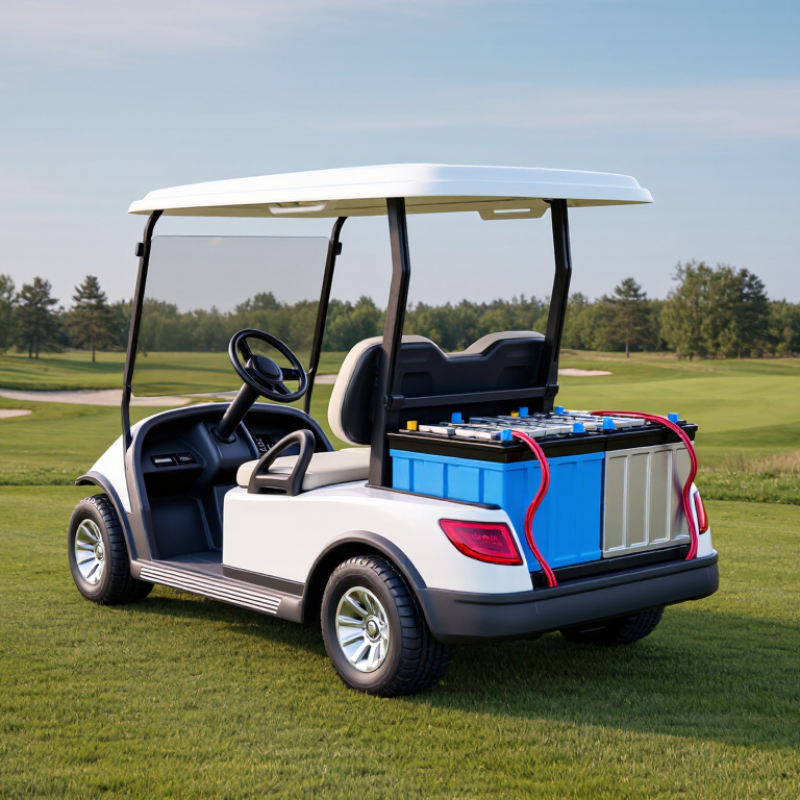
How to Choose a 173Ah Lithium Golf Cart Battery in 2026?
Define 173Ah Capacity: Compare 12.8V, 25.6V, and 51.2V Energy Ratings
A 173Ah rating describes stored charge, not total energy. Voltage completes the calculation. Use watt-hours: volts multiplied by amp-hours. A 12.8V, 173Ah battery stores about 2,214Wh. A 25.6V version stores roughly 4,429Wh. A 51.2V battery reaches approximately 8,858Wh.
That difference matters on the course. A 51.2V pack can suit a cart designed around a 48V nominal system. It may deliver stronger performance with less current through the cables. However, voltage must match the motor controller, charger, display, and protection system. Never select capacity alone.
A 12.8V battery may fit smaller utility carts or custom battery banks. Four units can create a 51.2V system, but wiring quality becomes critical. A 25.6V option may support two-unit configurations. Check series connection limits carefully.
Real driving distance varies. Hills, passenger weight, tire pressure, temperature, and driving speed all change consumption. In practical testing, a heavily loaded cart can use energy far faster than a level-course estimate suggests. I used to treat amp-hours as the main answer; that was too simple.
Measure the battery compartment before ordering. Confirm continuous discharge current, peak current, connector size, charging voltage, and battery weight. A reliable specification sheet should state usable energy, not only nominal figures. There is no perfect choice. There is only a better match for the cart’s electrical system and daily route.
Nominal energy comparison for 173Ah lithium batteries at different system voltages
A 173Ah battery does not provide the same amount of energy at every voltage. Nominal energy is calculated as Voltage × Capacity: 12.8V delivers approximately 2.21kWh, 25.6V delivers approximately 4.43kWh, and 51.2V delivers approximately 8.86kWh. Higher-voltage systems can provide more total energy while reducing current demand for the same power output. Actual usable energy may vary due to battery-management-system limits, temperature, wiring losses, and the recommended depth of discharge.
How to Choose a 173Ah Lithium Golf Cart Battery in 2026?
A 173Ah LiFePO4 battery can deliver steady energy, but capacity alone proves little. At 51.2 volts, it stores about 8.86 kWh before losses. Ask how that figure was measured. The U.S. Department of Energy’s Electric Vehicle Battery Test Procedures Manual emphasizes controlled temperature, discharge rate, and end-of-life capacity. These details matter because a 3,000-cycle rating at 25°C may not match a cart used on hot pavement.
Focus on 80% depth of discharge, or DoD. This means using 80% of the rated capacity during each cycle, not leaving 80% unused. A credible 3,000–5,000-cycle claim should state charging limits, current, temperature, and the remaining capacity threshold. Many tests define end of life near 80% original capacity. The 2024 International Energy Agency Global EV Outlook reported that LFP batteries represented more than 40% of global electric-car battery demand in 2023. That supports their growing acceptance, but golf-cart performance still depends on cell matching, thermal control, and battery-management software. Real carts are not lab benches.
Tips: Request a cycle-test report, not a marketing number. Check whether testing used 80% DoD. Ask for capacity retention after 3,000 cycles. Review the BMS temperature protections and charge history. A five-year-old pack may perform differently from a new sample. I would also compare usable amp-hours under your cart’s actual load, because acceleration can expose weaknesses that a gentle laboratory test misses.
A 173Ah lithium golf cart battery offers substantial stored energy, but capacity does not define power output. Check its continuous discharge current before installation. This rating shows how much current the battery can supply during regular driving. Compare it with the motor controller’s continuous demand, not only the motor’s advertised horsepower.
Peak current matters during hill starts, sudden acceleration, and soft ground. A cart may briefly demand much more power than it uses on level pavement. Review the battery management system’s peak-current rating and peak duration. For example, a 200-amp peak lasting ten seconds differs greatly from 200 amps lasting one minute. The specification must match real driving conditions.
I recommend measuring current with a suitable clamp meter during acceleration and uphill testing. Do this with a charged battery and normal passenger weight. I once judged a battery by amp-hours alone, and the cart felt weak on steep paths. That mistake was useful. Motor demand can rise sharply with heavy loads, low tire pressure, or aggressive gearing. Leave reasonable electrical headroom instead of matching ratings exactly. Also verify the battery voltage, controller limits, cables, and connectors. A high-capacity battery cannot compensate for undersized wiring or a controller that restricts current. Examine independent test data when available, and request clear continuous and peak discharge figures before purchasing.
| Check Item | Reference Value for a 173Ah Battery | How to Calculate or Verify | Selection Guidance |
|---|---|---|---|
| Nominal battery voltage | 51.2V nominal for a 16-cell LiFePO4 pack | 16 cells × 3.2V nominal per cell = 51.2V | Use only with a golf cart electrical system and charger designed for a 51.2V LiFePO4 battery. A nominal “48V” system commonly uses this battery voltage. |
| Rated capacity | 173Ah | Capacity is normally specified at a stated test temperature and discharge rate. Confirm the supplier’s test conditions. | Do not compare amp-hour values without checking voltage, test rate, temperature, and the battery management system’s cutoff limits. |
| Nominal energy | 8.86kWh | 51.2V × 173Ah = 8,857.6Wh, or approximately 8.86kWh | Use watt-hours rather than amp-hours when comparing batteries with different voltages. |
| Practical usable energy | Approximately 7.97kWh at 90% usable depth of discharge | 8.86kWh × 0.90 = 7.97kWh | Actual usable energy varies with temperature, battery age, discharge rate, reserve settings, and the battery management system. |
| Continuous battery current | Recommended reference: at least 200A for a high-power cart setup | Continuous current should be greater than the controller’s maximum sustained battery-side current. | A 100A-rated battery may be suitable for gentle use but can restrict acceleration and hill performance on a high-current controller. |
| Peak battery current | Recommended reference: 250–300A for approximately 5–10 seconds | Peak current is checked against short acceleration events, steep starts, and temporary overloads. | The battery management system must allow the required peak current without unexpectedly disconnecting. |
| Continuous electrical power at nominal voltage | About 10.24kW at 200A | 51.2V × 200A = 10,240W | This is battery-side electrical power, not motor shaft output. Motor, controller, wiring, and drivetrain losses reduce mechanical power. |
| Peak electrical power at nominal voltage | About 15.36kW at 300A | 51.2V × 300A = 15,360W | Confirm the permitted peak duration. A high peak rating does not mean the battery can sustain that load continuously. |
| Controller compatibility | Example controller demand: 150A continuous and 250A peak | Compare the controller’s battery-side current ratings with the battery’s continuous and peak BMS ratings. | Select a battery with a continuous rating above 150A and a peak rating above 250A, while following the manufacturer’s safety margin. |
| Flat-ground cruising demand | Approximately 1.5kW electrical input, or 29A at 51.2V | 1,500W ÷ 51.2V = 29.3A | Estimated operating time using 7.97kWh usable energy: about 5.3 hours under this constant-load assumption. |
| Rolling terrain demand | Approximately 3.0kW electrical input, or 59A at 51.2V | 3,000W ÷ 51.2V = 58.6A | Estimated operating time: about 2.7 hours under this constant-load assumption. |
| Moderate hill demand | Approximately 5.0kW electrical input, or 98A at 51.2V | 5,000W ÷ 51.2V = 97.7A | Estimated operating time: about 1.6 hours under this constant-load assumption. Repeated hills can increase battery temperature. |
| Acceleration demand | Approximately 8.0kW electrical input, or 156A at 51.2V | 8,000W ÷ 51.2V = 156.3A | The battery should support this demand without excessive voltage sag or BMS protection shutdown. |
| Voltage-sag check | Keep voltage drop low during high-current events | Voltage drop approximately equals current × total resistance of cells, busbars, cables, connectors, and fuse. | Check cable size, connector rating, fuse rating, and battery internal resistance—not only the amp-hour value. |
| Temperature operating range | Charging is commonly restricted below 0°C; exact limits depend on the battery design | Verify the battery management system’s charge and discharge temperature limits. | For cold climates, choose a battery with low-temperature charge protection or an approved heating system. |
| Final matching rule | Battery continuous current ≥ sustained controller demand; battery peak current ≥ temporary controller demand | Use the controller label, programming settings, motor specifications, terrain, passenger load, and tire size. | For demanding use, a 173Ah battery with approximately 200A continuous and 250–300A short-term peak capability is a practical reference target. |
Note: Runtime figures are theoretical estimates based on 7.97kWh usable energy and constant electrical load. Real driving time will be lower or higher depending on speed, terrain, payload, temperature, tire pressure, regenerative braking, motor efficiency, and driving style.
A 173Ah lithium battery can offer useful driving range, but capacity alone does not confirm compatibility. Measure the battery bay before ordering. Record its length, width, height, and cable clearance. Check the battery weight against the cart’s tray and suspension limits. A few extra centimeters can create pressure on terminals or prevent the cover from closing.
The battery management system, or BMS, deserves close attention. Confirm protection against overcharge, deep discharge, excessive current, overheating, and cell imbalance. Ask for continuous and peak current ratings, not only marketing figures. Check the IP rating, too. A higher rating can resist dust and water better, but it does not make the battery suitable for flooding. Review charging requirements and operating temperatures in the technical manual.
Tips: Photograph the empty compartment first. Compare every measurement with the specification sheet. Do not guess from an old lead-acid battery. Inspect connectors, fuse placement, and cable length. If the documentation is unclear, pause and ask a qualified technician. A common mistake is trusting the 173Ah label while overlooking BMS limits. That detail may matter more during a steep climb. Rechecking the measurements feels slow, but it is cheaper than correcting a poor fit later.
A 173Ah lithium golf cart battery can store different energy amounts, depending on voltage. At 51.2V, the calculation is 51.2 × 173, or 8.86kWh. At 48V, it provides about 8.30kWh. A realistic 90% usable-depth limit leaves approximately 7.97kWh or 7.47kWh. That difference affects range, charging frequency, and value. The U.S. Department of Energy reports that battery performance depends heavily on temperature, charging behavior, and usable capacity, not only rated capacity.
Look beyond the purchase price. BloombergNEF’s 2024 Battery Price Survey reported an average lithium-ion pack price of $115 per kWh, down 20% from 2023. Retail golf-cart pricing includes electronics, casing, installation, support, and margin, so this figure is not a direct shopping target. My first comparison used rated kWh, and it looked precise. It was not. Calculate total cost of ownership as purchase price plus installation and charging costs, divided by expected usable kWh over the warranty period. A five-year warranty sounds strong, but check its cycle limit, minimum capacity guarantee, labor coverage, and prorated reductions. Some warranties exclude deep discharge, freezing temperatures, or unapproved chargers. A battery promising 3,000 cycles may deliver only 80% capacity at that point. That detail changes the math. Keep invoices and voltage records. Reliability is easier to judge with evidence.
It describes stored charge, not total energy. Voltage completes the calculation. Watt-hours equal volts multiplied by amp-hours.
A 12.8V battery stores about 2,214Wh. A 25.6V battery stores roughly 4,429Wh. A 51.2V battery stores approximately 8,858Wh.
It may suit a cart designed around a 48V nominal system. Confirm compatibility with the motor controller, charger, display, and protection system. Never choose capacity alone.
Four 12.8V units can form a 51.2V system. Two 25.6V units may also work. Check series connection limits and wiring quality carefully.
Hills, passenger weight, tire pressure, temperature, and speed all change consumption. A heavily loaded cart may use energy quickly. Level-course estimates can mislead.
Measure length, width, height, and cable clearance inside the battery compartment. Check connector size, cable length, battery weight, and fuse placement. A few centimeters matter.
Look for protection against overcharging, deep discharge, excessive current, overheating, and cell imbalance. Confirm continuous and peak current ratings. Marketing figures are not enough.
A higher rating can resist dust and water better. It does not make the battery suitable for flooding. Review operating temperatures and charging requirements.
Compare purchase price, installation, charging costs, and expected usable energy. A 90% usable-depth limit reduces the advertised capacity. Check cycle limits, capacity guarantees, labor coverage, and prorated reductions.
Do not trust the 173Ah label without checking BMS limits and physical fit. I once treated amp-hours as the whole answer. That was too simple.
Choosing a 173Ah lithium golf cart battery in 2026 requires more than comparing the amp-hour rating. First, convert capacity into usable energy by checking the battery voltage: 12.8V, 25.6V, and 51.2V systems provide different total kWh and may suit different cart designs. LiFePO4 chemistry is valued for its durability, so review the rated 3,000–5,000 cycle life and calculate real-world performance at an 80% depth of discharge.
The battery must also match the cart’s motor demand. Compare continuous current, peak power, and controller requirements to avoid reduced performance or protective shutdowns. Confirm that the battery’s BMS, IP rating, dimensions, terminals, and weight fit the vehicle and intended environment. Finally, evaluate 2026 value by comparing usable kWh, warranty coverage, charging needs, installation costs, and expected total cost of ownership rather than focusing only on the purchase price.