Choosing the China best 6-passenger lifted golf cart requires more than comparing prices. A reliable manufacturer should prove its experience through real production details, field testing, and responsive support. Buyers should inspect frame welding, suspension geometry, hydraulic braking, battery protection, and seating materials. A tall cart may look powerful beside a warehouse or resort road. However, poor weight distribution can make every turn feel nervous.
Michael S. McCart, an independent golf-cart engineering consultant, once said, “Lifted performance begins with controlled stability, not oversized tires.” This principle deserves attention. A strong 6-passenger lifted golf cart should combine useful ground clearance with predictable handling. Its lift kit must match the axle, motor, controller, and braking system. Bigger tires alone do not create better performance.
China has many manufacturers, but quality levels vary widely. The strongest suppliers usually offer battery options, custom colors, weather-resistant seats, lighting packages, and replacement parts. They also explain testing procedures instead of hiding behind attractive photographs. Ask for load ratings, charging information, warranty terms, and delivery records. Speak with previous fleet customers when possible.
There is no perfect cart.
Even experienced buyers can overlook small details, such as seat-belt mounting points or charger ventilation. A factory visit may reveal more than a polished catalog. The best manufacturer is not always the cheapest. It is the supplier that can document consistent assembly, honest specifications, and practical after-sales service. For resorts, communities, campuses, and private estates, that evidence should guide the final decision.
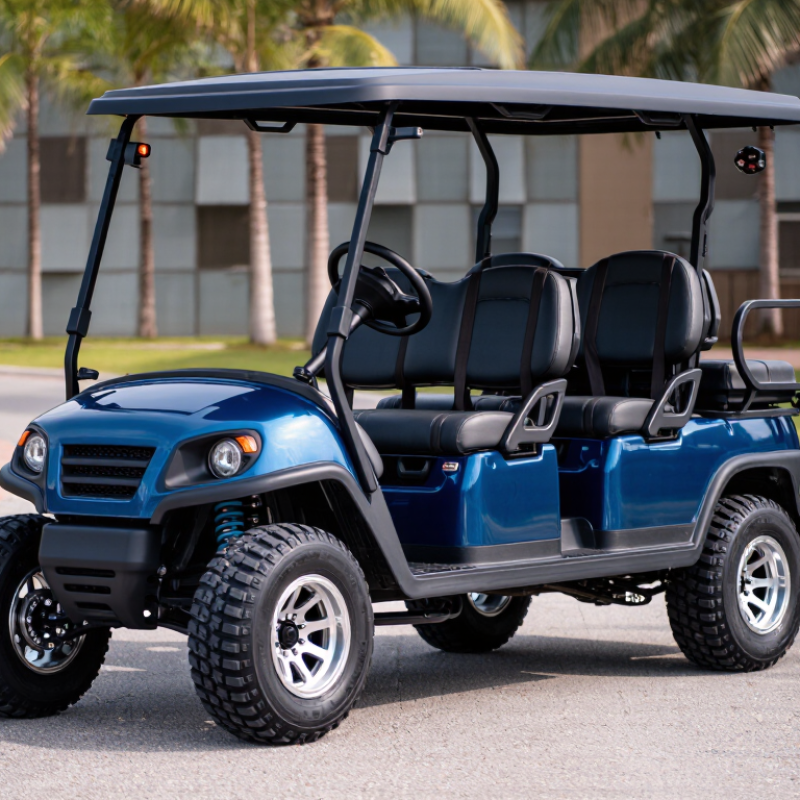
A high-quality 6-passenger lifted golf cart begins with a strong frame and carefully finished welds. The chassis should remain stable when all seats are occupied. A suitable lift system must provide clearance without making the vehicle feel top-heavy. Oversized tires may look impressive, but they can reduce efficiency and increase steering effort. Balanced suspension matters more than appearance.
Reliable braking is essential. Hydraulic or well-adjusted mechanical brakes should stop the cart smoothly on slopes and uneven paths. The steering system should respond without excessive play. Battery capacity, motor output, and controller settings must match the passenger load. A cart that performs well with two people may struggle with six adults. Real-world testing is necessary.
Check the seating structure, handholds, flooring, lights, mirrors, and weather-resistant wiring. Small details often reveal manufacturing discipline. During evaluation, inspect battery connections and listen for suspension noise after repeated driving. A high-quality cart should also offer clear maintenance guidance and accessible replacement parts. I have found that a larger lift kit is not automatically better. It may create extra wear when the frame, brakes, or steering components are not upgraded together. That point deserves honest review.
A Chinese manufacturer can offer practical advantages for a six-passenger lifted golf cart. China has a dense supply chain for motors, batteries, axles, controllers, and steel frames. This usually supports faster customization and more competitive pricing. According to Grand View Research, the global golf cart market was estimated at about USD 1.87 billion in 2023. Demand is also expected to grow steadily through 2030. That growth encourages manufacturers to improve production quality and export experience.
A lifted cart needs more than a taller suspension. Its frame, braking system, steering parts, and battery layout must work together. Experienced factories can adjust ground clearance, seating space, tire size, and cargo capacity for different terrains. Ask for load tests, battery data, welding standards, and inspection records. Do not trust attractive photos alone. A low price may hide weak components. I have seen this mistake before. The cheapest quotation is not always the lowest long-term cost.
Tips: Request a sample or factory video inspection. Confirm the warranty in writing. Check whether spare parts are available for several years. Also verify compliance with the destination market’s safety requirements. Chinese production can be efficient, but quality control still depends on the factory, not the country alone. That point deserves honest attention.
China Best 6 Passenger Lifted Golf Cart Manufacturer?
Choosing a Chinese manufacturer requires more than comparing painted bodies and advertised prices. Grand View Research valued the global golf cart market at about USD 1.7 billion in 2023, with continued growth expected through 2030. This expansion increases supplier choice. It also increases comparison risks.
For a six-passenger lifted cart, inspect the frame, axle rating, and suspension geometry. Ask for payload data with six adults aboard, not an empty-cart specification. Ground clearance should be measured under the lowest component. Check turning radius, hill-climbing performance, braking distance, and tire load ratings. A useful factory test includes a fully loaded cart crossing uneven gravel, stopping on a slope, and repeating the route after battery discharge. Small details matter. Loose wiring does not.
Battery chemistry, motor output, controller protection, and charger compatibility deserve equal attention. Request cycle-life evidence from independent laboratory reports, not only internal brochures. The International Energy Agency reported that global electric car battery demand exceeded 750 GWh in 2023, showing the importance of battery quality and supply consistency across electric transport. For golf carts, compare usable capacity, charging time, thermal protection, and replacement cost. Manufacturing quality should be verified through production records, inspection photographs, and traceable component lists. Warranty response time matters too. Some suppliers promise quickly, then communicate slowly. That remains a real weakness. A factory audit, sample inspection, and spare-parts plan can reveal more than a polished showroom.
| Comparison Dimension | Typical Specification to Compare | Recommended Benchmark for a 6-Passenger Lifted Cart | Why It Matters | Documents or Tests to Request |
|---|---|---|---|---|
| Passenger Capacity | Two forward-facing rows with six individual seating positions | Rated for 6 passengers, with seat belts and grab handles for every seating position | Confirms that the vehicle is designed for its stated occupancy rather than simply having additional cushions | Seat layout drawing, rated-capacity label, seat-belt specification, and static-load test results |
| Lifted Suspension | Suspension lift height, spring or coil configuration, shock absorbers, and steering geometry | Approximately 4–6 inches of lift with matched shocks, reinforced mounting points, and properly aligned steering components | A lifted chassis requires compatible suspension and steering parts to maintain stability and handling | Suspension drawings, component material details, alignment data, and loaded-road test video |
| Ground Clearance | Clearance measured at the lowest fixed point under the chassis | Commonly about 6–8 inches, measured with the cart in its normal operating condition | Higher clearance improves performance on grass, gravel, and uneven private roads, but may raise the center of gravity | Dimension sheet showing measurement method, tire size, and loaded/unloaded clearance |
| Drive Motor | Motor type, continuous power, peak power, torque, and cooling method | 48 V AC motor, commonly around 5–7.5 kW peak output for a six-passenger lifted configuration | Motor output affects hill climbing, acceleration, energy consumption, and performance with a full passenger load | Motor nameplate, controller compatibility data, rated/peak power definition, and hill-climb test results |
| Battery System | Battery chemistry, voltage, capacity, protection system, and serviceability | 48 V system; lithium packs commonly range from approximately 100–150 Ah, while lead-acid configurations are usually specified by total Ah and battery count | Battery capacity, weight, charging behavior, and maintenance requirements strongly influence operating cost | Battery datasheet, BMS specifications, UN 38.3 documentation for lithium batteries, and warranty terms |
| Driving Range | Distance per charge under a clearly defined test condition | Approximately 50–100 km per charge, depending on battery type, passenger load, terrain, temperature, and speed | A range figure without test conditions cannot be used reliably for purchasing decisions | Test protocol, vehicle load, average speed, terrain, temperature, battery state of health, and measured results |
| Maximum Speed | Factory-limited top speed and optional speed settings | Typically 25–40 km/h, subject to local low-speed vehicle and private-property regulations | Speed must match the intended site, road permissions, braking capability, and local legal requirements | Controller settings, speedometer calibration data, compliance statement, and local registration guidance |
| Controller and Regenerative Braking | Controller current rating, regenerative braking, downhill control, and diagnostic functions | Programmable 48 V controller with smooth acceleration, regenerative braking, and fault-code diagnostics | Proper controller matching improves low-speed control, hill performance, and battery efficiency | Controller datasheet, wiring diagram, diagnostic-code list, and loaded downhill test |
| Braking System | Mechanical or hydraulic brakes, parking brake, brake balance, and stopping distance | Four-wheel braking with a dependable parking brake and documented stopping performance at rated load | Six passengers and lifted tires increase the importance of predictable braking on slopes | Brake-system drawing, pad or drum specifications, parking-brake test, and stopping-distance results |
| Tires and Wheels | Tire diameter, load index, tread pattern, wheel size, and offset | Approximately 12–14 inch tires with a load rating suitable for the vehicle’s gross weight and intended surface | Oversized tires affect speed, braking, steering load, suspension travel, and motor efficiency | Tire markings, load-index information, wheel offset, inflation-pressure chart, and spare-parts availability |
| Frame and Body | Frame material, weld quality, corrosion protection, body material, and roof structure | Welded steel frame with anti-corrosion treatment, UV-resistant body panels, and a reinforced roof or canopy | Frame strength and corrosion protection influence service life, especially in humid or coastal environments | Material specification, coating process, weld inspection records, and corrosion-protection details |
| Payload and Towing Capacity | Maximum passenger and cargo payload, axle limits, and permitted trailer load | Payload commonly falls around 450–600 kg, but the approved value must be confirmed from the vehicle specification | A six-passenger cart may have limited remaining capacity for luggage, tools, or commercial equipment | Gross vehicle weight rating, axle-load data, payload test, and tow-hitch rating if applicable |
| Dimensions and Turning Radius | Overall length, width, height, wheelbase, and turning radius | Length often measures approximately 3.6–4.2 m; confirm width and turning radius against the intended site | A longer lifted six-passenger vehicle may not fit narrow paths, garages, elevators, or transport trailers | Dimension drawing including mirrors, canopy, rear seat, bumper, and turning-circle measurement |
| Charging Equipment | Charger input voltage, output current, charging time, waterproof rating, and connector type | Automatic charger matched to the battery chemistry; typical charging time is approximately 6–10 hours from a low state of charge | Incorrect charging equipment can reduce battery life and create safety or compatibility problems | Charger label, charging curve, input-power requirement, safety certification, and replacement availability |
| Safety Equipment | Seat belts, mirrors, lighting, horn, reflectors, reverse alarm, and emergency isolation | Three-point or lap belts as required by the application, LED lighting, mirrors, horn, and clearly accessible main disconnect | Safety equipment should be selected according to passenger use, operating environment, and local regulations | Safety checklist, wiring diagram, lighting specifications, user manual, and inspection report |
| Quality Control | Incoming inspection, process control, final inspection, and traceability | Documented inspection checkpoints for frame welding, battery installation, torque settings, wiring, braking, and road testing | Consistent quality depends on repeatable processes rather than appearance alone | Quality manual, sample inspection report, serial-number traceability, and pre-shipment test video |
| Customization Capability | Seating layout, battery type, colors, cargo accessories, weather equipment, and electrical options | Written confirmation of engineering changes, minimum order quantities, tooling charges, and production lead time | Custom options can affect vehicle weight, balance, certification, range, and spare-parts compatibility | Approved technical drawing, bill of materials, sample approval process, and change-control procedure |
| Export Compliance | Applicable electrical, battery, transport, and destination-market requirements | Compliance documents should match the exact model, battery, charger, and destination country | Documents issued for a different configuration may not support customs clearance or local registration | Declaration of conformity where applicable, battery transport documents, test reports, manuals, and packing list |
| Warranty and After-Sales Support | Warranty duration, covered parts, response time, remote diagnosis, and spare-parts supply | Clear written coverage for the frame, motor, controller, charger, battery, and wear parts, with a practical spare-parts plan | A competitive purchase price may become expensive if technical support and replacement parts are difficult to obtain | Warranty policy, response-time commitment, parts price list, troubleshooting guide, and service contact process |
| Total Cost of Ownership | Purchase price, freight, duties, energy, batteries, tires, service, and replacement parts | Compare the complete delivered cost over a three- to five-year operating period rather than unit price alone | Battery replacement, shipping, charging energy, and maintenance can materially change the final operating cost | Commercial quotation, estimated freight and duties, maintenance schedule, battery-life assumptions, and spare-parts pricing |
Note: The ranges shown are general purchasing benchmarks for lifted six-passenger electric golf carts. Exact specifications vary by configuration, battery chemistry, terrain, payload, and destination-market requirements; confirm all figures in the final technical specification and contract.
When evaluating a six-passenger lifted golf cart, look beyond paint, tire size, and showroom lighting. A reliable manufacturer should provide clear test records for frame strength, braking distance, steering response, and maximum load. Ask how the cart behaves on uneven ground, not only on smooth factory floors. During inspection, check welded joints, suspension mounts, battery cables, and charger connections. Loose terminals or uneven welds can reveal weak production control.
Safety depends on design and daily use. Confirm seat belts, handrails, mirrors, lighting, and a dependable parking brake. The lifted suspension should improve clearance without making the vehicle unstable during turns. Request the center-of-gravity data and recommended passenger weight. Compliance also matters. Verify that electrical parts, batteries, chargers, and safety systems meet the standards required in your destination market. Documentation should include manuals, inspection reports, warranty terms, and traceable component information. A certificate alone is not enough.
Tips: Test a loaded vehicle before purchase. Drive slowly over a ramp, brake on a slope, and listen for unusual movement. Check whether every seat remains secure. Ask for spare-parts support and maintenance guidance. Visit the production site if possible. Photos can hide defects. I have seen attractive carts fail simple checks because inspection focused too heavily on appearance. That mistake is easy to repeat. Evaluate the manufacturer’s process, records, and response to difficult questions.
Choosing China’s best six-passenger lifted golf cart manufacturer starts with your market, not a catalog photo. A lifted cart may suit resorts, campuses, farms, or private communities. Each setting demands different ground clearance, braking, range, and weather protection. In supplier evaluations, I write a practical duty profile first. Include passenger load, daily distance, slope, surface type, charging access, and storage conditions. Keep it specific. “Heavy use” is not enough.
Visit or independently audit the factory when possible. Check whether the supplier controls welding, painting, battery installation, wiring, and final inspection. Ask for test records covering frame strength, brake performance, steering, hill control, charger safety, and battery endurance. Request a complete specification sheet, not verbal promises. Confirm motor rating, controller protection, tire size, seating materials, and usable payload. A sample vehicle should operate on your actual route. A smooth showroom floor proves little.
Reliable suppliers explain production lead times, replacement parts, training, warranty limits, and technical support before payment. They should provide clear manuals and market-appropriate compliance documents. Compare total ownership cost, including batteries, shipping, maintenance, and downtime. Price alone can hide weak components. It is easy to underestimate after-sales response time, especially when several vehicles need repairs. Ask difficult questions early. The best supplier may not be the cheapest or most polished. It should document performance, admit limitations, and adapt responsibly to your operating needs.
This procurement framework assigns practical importance to the main factors buyers should evaluate before selecting a supplier. Compliance, battery performance, after-sales support, customization, delivery reliability, and total cost should be assessed together rather than by price alone.
It needs a strong frame, clean welds, stable suspension, and reliable brakes. All seats matter. The chassis should remain steady with six adults onboard. A taller lift alone does not prove quality.
The lift should increase ground clearance without making the cart feel top-heavy. Oversized tires can increase steering effort and reduce efficiency. Balanced suspension matters more than dramatic appearance. Bigger is not always better.
Hydraulic or properly adjusted mechanical brakes should stop the cart smoothly. Test braking on slopes and uneven paths. Check the parking brake carefully. Weak braking is a serious warning.
Test the cart with its expected passenger load. Check motor output, battery capacity, and controller settings together. A cart that handles two people may struggle with six adults. Real testing reveals uncomfortable surprises.
Examine seat structures, handholds, flooring, lights, mirrors, and weather-resistant wiring. Every seat should remain secure during slow turns and uneven travel. Look for secure battery cables and charger connections. Small details matter.
Request load tests, braking results, steering checks, inspection records, manuals, and warranty terms. Ask for recommended passenger weight and center-of-gravity information. A certificate alone is not enough. Records should be clear and traceable.
Inspect welded joints, suspension mounts, battery terminals, and frame connections. Ask for a sample, factory video, or site visit when practical. Photos can hide uneven welds and loose hardware. I might still miss something.
Confirm spare-parts availability for several years and request practical maintenance guidance. Check whether common parts can be replaced without unusual tools. Review warranty coverage in writing. Cheap purchases can become expensive later.
A low quotation may reflect weaker frames, brakes, batteries, or steering components. Compare testing records, component quality, support, and warranty coverage. The cheapest option is not always economical. That lesson deserves reflection.
Choosing the best 6-passenger lifted golf cart requires more than comparing appearance or price. A high-quality model should combine a strong frame, reliable power system, stable lifted suspension, comfortable seating, effective brakes, durable tires, and practical safety features. Chinese manufacturers can offer broad production capacity, flexible customization, competitive pricing, and access to varied electric powertrain and component options. However, buyers should carefully compare load capacity, battery performance, motor efficiency, suspension design, weather protection, spare-parts availability, and after-sales support.
To select the right supplier, evaluate its manufacturing experience, quality-control procedures, testing standards, documentation, and ability to meet the regulations of your target market. Confirm that the vehicle’s electrical system, braking performance, lighting, seating, and structural design are suitable for intended use. Clear communication, sample testing, transparent quotations, warranty coverage, and dependable delivery are also essential. The best supplier is one that consistently balances product quality, safety, customization, service, and long-term operating value.